SPINS to Slide Deck: What Happens When the Pipeline Runs Itself
The Monday ritual every brand manager knows — and what it looks like when a pipeline handles it instead. 312 hours a year, reclaimed.
By Zach Newton · Feb 24, 2026
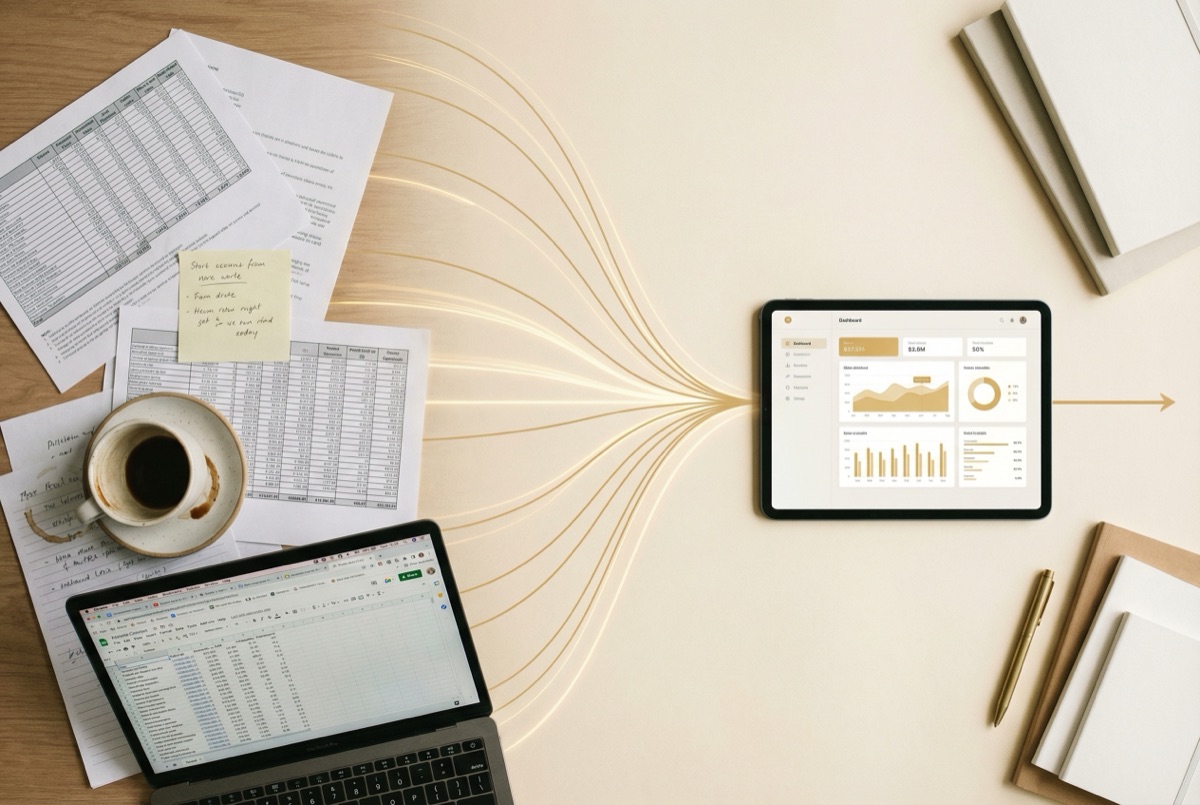
It's Monday morning. You open your laptop, and the ritual begins.
Download the latest SPINS data. Open the Excel template you've been maintaining since 2022 — the one with 14 tabs and a pivot table that breaks if you look at it wrong. Copy the new numbers in. Manually adjust for the retailer that changed their category hierarchy last month. Pull up the KeHE portal in one tab, UNFI in another. Cross-reference sell-through against your promo calendar. Grab competitor pricing from the retailer portals that still require you to click through six screens to export a CSV.
Build the deck. Paste in the charts. Write the same three talking points you wrote last week, but with new numbers. Email it to leadership by noon.
You've done this so many times you could do it in your sleep. And that's the problem.
The hidden tax on every brand team
I spent almost a decade in CPG operations — KRAVE Jerky at Hershey, Navitas Organics, Mezzetta — and at every single one, some version of this Monday ritual existed. The tools changed. The ritual didn't.
Here's what it actually costs when you add it up:
- Syndicated data pull and cleanup: 2-3 hours/week
- Retailer portal exports (KeHE, UNFI, DSD distributors): 1-2 hours/week
- Cross-referencing against promo calendar and trade spend: 1 hour/week
- Building the weekly update deck: 1-2 hours/week
That's 5-8 hours per week on a single recurring workflow. Call it 6 hours average. Multiply by 52 weeks: 312 hours a year. Even if you're only doing this rigorously 50% of the time — maybe you skip weeks, maybe an intern handles it sometimes — that's still 156 hours.
And that's one workflow. Most brand managers are running four or five of these in parallel. Broker scorecards. Competitive price tracking. New item velocity reports. Trade promo post-mortems.
The cumulative number is staggering. Not because any single task is hard. Because none of them should require a human.
What "automated" actually looks like
When people hear "automate your data stack," they picture some AI magic box that replaces their job. That's not what this is.
It's a pipeline. Boring word, but accurate.
Your SPINS data has an export format. It's the same format every time. Your Excel template has a structure. It's the same structure every time. The KeHE portal has a data export. Same fields, same CSV. Your promo calendar lives in a Google Sheet with a predictable schema.
Every piece of this workflow is structured, repetitive, and rule-based. Which means every piece of it can be connected.
What that looks like in practice:
- Sunday night, 11 PM: A script pulls the latest SPINS data via their API. Pulls KeHE and UNFI sell-through. Pulls your promo calendar from the shared Google Sheet.
- Sunday night, 11:02 PM: A cleaning step normalizes the data — fixes the retailer that changed their hierarchy, maps distributor SKUs to your internal codes, flags any missing data points.
- Sunday night, 11:05 PM: The analysis runs. Week-over-week velocity changes. ACV shifts. Promo lift calculations. Competitor pricing deltas against your benchmark set.
- Sunday night, 11:06 PM: A dashboard updates. A deck template populates. Anomalies get flagged — that 15% price drop from your biggest competitor, the distribution gap in the Southeast, the promo that delivered 0.3x lift instead of the planned 2x.
- Monday morning, 7:00 AM: You open a finished report. You add two sentences of commentary. You hit send.
Total human time: 15 minutes. Same output. Actually better output, because the pipeline doesn't fat-finger a VLOOKUP or forget to update the competitor set.
Why this hasn't happened yet
If this is so straightforward, why is every brand manager still copy-pasting?
Three reasons.
First, nobody on the team is a data engineer. Brand managers are marketers. Ops directors are operators. They know the workflow cold, but they don't know how to build a pipeline. And they shouldn't have to.
Second, IT is busy. Every CPG company's IT team has a backlog measured in quarters, not weeks. Your Monday report isn't going to leapfrog the ERP migration.
Third, the consultants who sell "AI strategy" don't know SPINS from Nielsen. They'll build you a beautiful slide deck about digital transformation. They won't know that KeHE changed their portal login flow last quarter, or that UNFI's data export has a known issue with organic category codes.
The gap isn't technology. The technology exists today — API connections, data transformation scripts, LLMs that can generate narrative summaries from structured data. None of this is cutting-edge. It's just plumbing.
The gap is someone who's been in your seat — who knows which 4 hours of your workflow a model can eat in 12 minutes, and can evaluate the right tools, bring them in, and wire them into something that runs itself. Not another vendor. An integrator.
The math that matters
Here's the calculation I always come back to:
A brand manager at a $30M CPG company makes somewhere between $90K and $130K, fully loaded. Call it $110K. That's roughly $53/hour.
If they're spending 300 hours a year on data wrangling that a pipeline could handle, that's $15,900 in salary spent on copy-paste. For one person. Most brand teams have two or three people doing versions of this.
But the real cost isn't the salary. It's the strategic work that doesn't happen. The competitive analysis that gets skipped because there's no time. The new retail pitch that uses last quarter's data because nobody could pull the fresh numbers fast enough. The promo post-mortem that never gets done because everyone moved on to the next fire.
You didn't hire a brand manager to be a data entry clerk. But that's what Monday looks like.
NWTN AI is the integrator for CPG brands navigating AI — we evaluate the landscape, bring in the right tools, and wire them into workflows that actually run. If your Monday looks like this, let's talk.
10 years in CPG operations — from KRAVE Jerky to Mezzetta. Now helps CPG brands navigate the AI landscape — evaluating, bringing in, and integrating the right tools.
LinkedIn ↗See what 10 hours of manual work looks like automated.
Book a Free Audit Call →