The Brand Manager's Monday: Before and After AI Integration
Same outputs. Zero copy-paste. What Monday looks like when the busywork disappears.
By Zach Newton · Feb 17, 2026
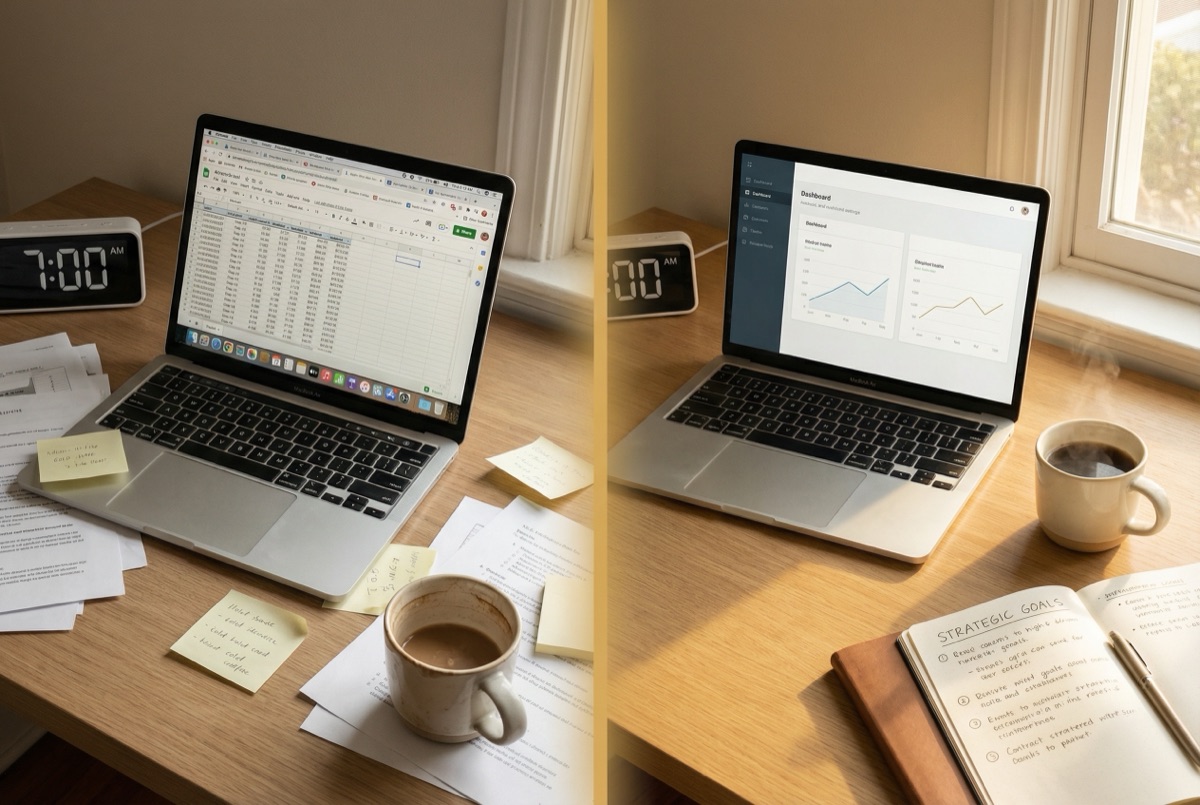
Every brand manager I've worked with has the same relationship with Monday. It's not about meetings or emails. It's about the 5-hour gauntlet between opening your laptop and doing anything that actually requires your brain.
Here's what that looks like. Then here's what it could look like.
Before: The Monday gauntlet
7:00 AM — Email triage and broker reports
Your inbox has 14 new messages from Friday afternoon. Three are from brokers with PDF attachments — monthly scorecards that need to be manually entered into your tracking spreadsheet. One has a formatting change from last month. You spend 20 minutes figuring out which columns moved.
8:00 AM — Syndicated data pull
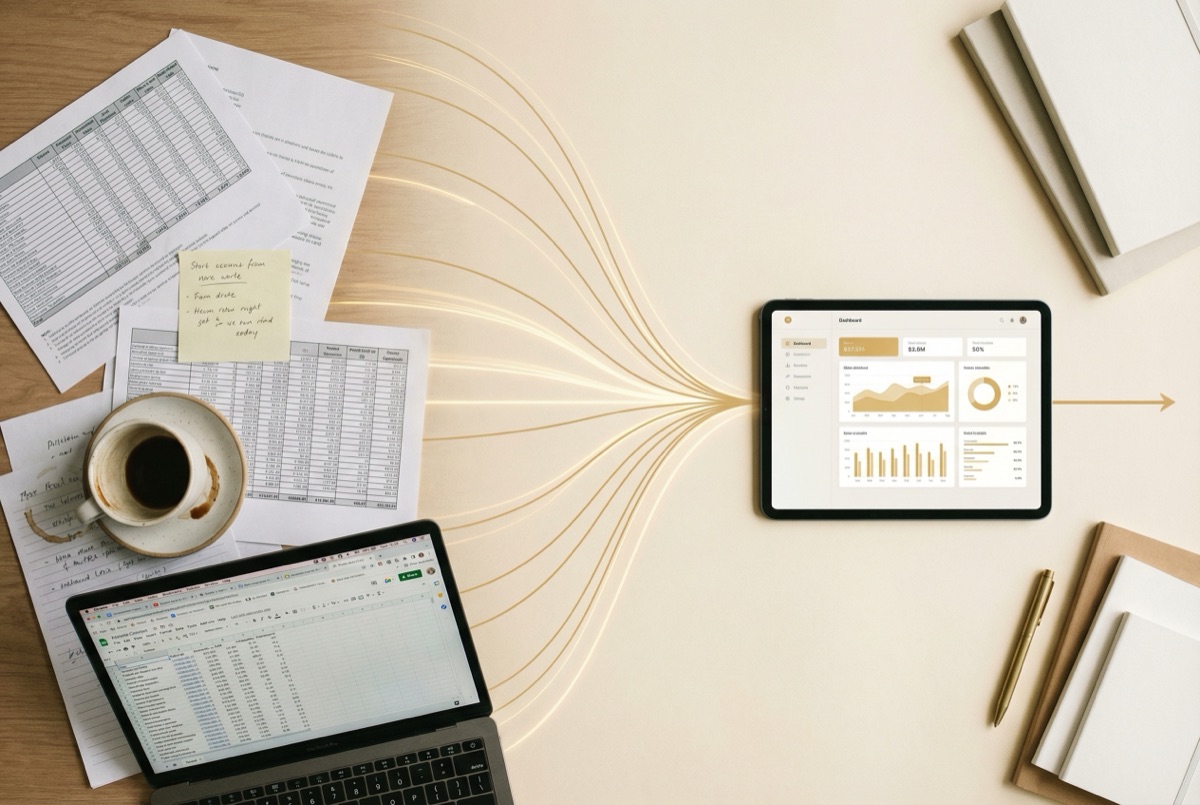
Log into SPINS. Navigate to the saved report. Download the CSV. Open your master Excel workbook — the one with 16 tabs, a nested VLOOKUP chain, and conditional formatting that someone set up in 2023 and nobody fully understands. Paste in the new data. Fix the three cells that broke because a retailer changed their category naming. Rebuild the pivot table.
9:30 AM — Competitor pricing check
Open the Kroger supplier portal. Export pricing for your category. Open the Whole Foods portal — different login, different format. Open Amazon and manually spot-check three competitor ASINs. Log everything in your competitive tracking sheet. Notice that your main competitor dropped their price by $0.40 at Kroger. Flag it, but you won't have time to dig into it today.
10:30 AM — Promo calendar cross-reference
Open the trade promo calendar in Google Sheets. Compare last week's promoted items against the velocity data you just pulled. Try to calculate promo lift, but the baseline numbers are from two months ago because nobody updated them. Estimate it. Move on.
11:30 AM — Build the weekly update deck
Open last week's PowerPoint. Duplicate the slides. Swap the numbers. Update the charts — manually, because the chart data isn't linked to your spreadsheet. Write the same executive summary format: top-line sales, distribution update, competitive callouts, promo performance. Screenshot the key tables. Paste them in. Align them. Email the deck to your VP.
12:30 PM — Start your actual job
Five and a half hours in. You haven't done a single thing that requires strategic thinking. No innovation. No planning. No analysis that goes deeper than "what happened last week." You're a $110K/year data entry clerk until lunchtime.
And you'll do it again next Monday.
After: The same Monday, automated
7:00 AM — Review the dashboard
Open your laptop. The weekly dashboard is already built. Syndicated data was pulled from SPINS overnight. KeHE and UNFI sell-through was pulled at the same time. Competitor pricing was checked across all tracked retailers. Everything was cleaned, normalized, and loaded into your reporting template — the same template, the same format your leadership team expects.
Time: 5 minutes to scan the numbers and confirm nothing looks off.
7:15 AM — Check the flags
The system flagged three things overnight:
- Your main competitor dropped their Kroger price by $0.40 (the same thing that would have taken you until 9:30 AM to find manually)
- A distribution gap opened — you lost two stores in the Southeast region
- Last week's promo delivered 0.8x lift against a 2x target
Each flag links to the underlying data. You can dig in or skip — but you know about it at 7:15, not whenever you happen to get to that part of your spreadsheet.
Time: 10 minutes.
7:30 AM — Finalize the deck
The weekly update deck is pre-built. Same format as always. Charts populated, tables filled, competitive section written from the flagged data. You add three lines of commentary — your interpretation, your recommendation, the thing that actually requires a brand manager's judgment. Hit send.
Time: 15 minutes.
7:45 AM — Strategic work
It's not even 8 AM and you're done with reporting. The rest of the day is yours for the work you were actually hired to do. The new retail pitch. The innovation pipeline review. The deep-dive on why that promo underperformed. The competitive response to that price drop — which you found out about at 7:15, not next Friday.
Total time on "Monday reporting": 45 minutes. Same outputs. Same deck format. Same data sources. Zero copy-paste.
What changed (and what didn't)
The job didn't change. The deliverables didn't change. Leadership still gets their Monday deck. The data still comes from SPINS and KeHE and UNFI.
What changed is that the structured, repetitive, rule-based parts — download, clean, format, cross-reference, populate — got handed to a pipeline that runs overnight. The parts that actually need a human — interpretation, judgment, strategy — those stayed right where they belong.
Nobody got replaced. Somebody got their mornings back.
That's 5 hours a week. 250 hours a year. For one person on one workflow.
The busywork disappeared. The job got better.
NWTN AI is the integrator that turns "before" into "after" for CPG brand teams — evaluating, bringing in, and wiring together the right tools, from someone who's lived the workflow. Book a 30-minute call to walk through your Monday.
10 years in CPG operations — from KRAVE Jerky to Mezzetta. Now helps CPG brands navigate the AI landscape — evaluating, bringing in, and integrating the right tools.
LinkedIn ↗See what 10 hours of manual work looks like automated.
Book a Free Audit Call →