What a CPG AI Department Actually Does
It's not another tool. It's not a single hire. It's the function that evaluates, brings in, and connects everything across your brand.
By Zach Newton · Feb 24, 2026

If you're running a CPG brand doing $5M–$100M, you've probably been in this exact position.
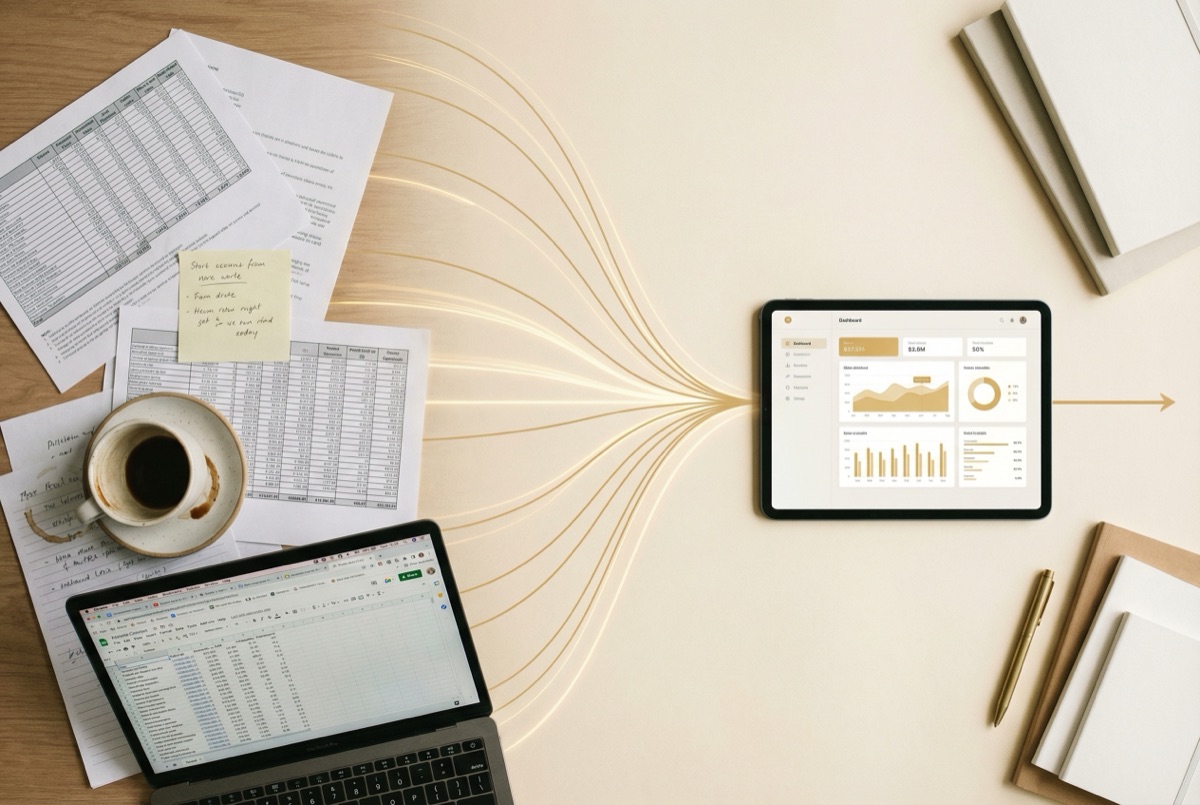
Your team is pulling SPINS data manually, copy-pasting into Excel, building the same deck every Monday. Someone on the ops side just bought a demand planning tool that nobody knows how to use. The sales team is still running broker scorecards by hand because IT has a six-month backlog. And the CEO just came back from Expo West talking about how "everyone's doing AI now."
You need help. You know you need help. But when you look at the options, it breaks down into two buckets:
-
Buy another tool. Crisp. Bedrock. Vividly. SupplyPike. Each one solves one problem, costs $20K–$80K a year, and requires someone to actually implement and manage it.
-
Hire a head of AI/data. Post a role, wait three months, pay $200K–$300K fully loaded, hope they understand CPG, and pray they don't leave in 18 months.
Neither option works. The first gives you a pile of disconnected tools with nobody driving. The second is a massive bet on a single hire in a market where everyone's fighting over the same talent.
There's a third option that most brands haven't considered yet.
What an AI department actually does
When I was at Mezzetta, we didn't have an AI department. Nobody at our size did. But we needed one. We had SPINS data, Crisp dashboards, trade promo spreadsheets, broker scorecards, and a dozen manual processes that ate hours every week.
What we actually needed wasn't another tool or a single hire. We needed a function — a department — that could:
- Evaluate the landscape and tell us which tools were worth it and which were noise
- Select the right 2-3 platforms for our specific data sources and workflows
- Bring them in — handle the vendor conversations, negotiate, get us set up
- Integrate them so they actually talked to each other and to our existing stack
- Build custom solutions for the gaps no vendor covers (broker scorecards from raw KeHE/UNFI data, for example)
- Manage the whole thing ongoing — optimize, troubleshoot, add new tools as the landscape shifts
That's not a tool. That's not a consultant. That's a department.
Why one hire doesn't solve it
Let's say you go the hire route. You post for a "Head of AI" or "Director of Data & Analytics." Best case, you get someone in the seat in 90 days.
Here's the problem: the skills you need span at least three roles.
You need someone who understands CPG operations — who's pulled SPINS data, managed trade spend, survived a broker QBR. You need someone who knows the AI tool landscape — not just the big names, but the niche players that actually solve specific CPG problems. And you need someone who can implement — not just recommend tools, but wire them into your workflow so they run without babysitting.
Finding one person who does all three? That's a unicorn. And unicorns cost $250K+.
Even if you find them, you're putting the entire function on one person's shoulders. They leave, and you're back to square one.
The math
A fractional AI department — someone who comes in, evaluates your stack, brings in the right tools, integrates them, and manages it ongoing — runs $5K–$10K per month. Call it $7.5K average. That's $90K a year.
A full-time hire doing the same work costs $200K–$300K fully loaded (salary, benefits, equity, the three months you're paying a recruiter while the seat is empty).
For the price difference, you get:
- Immediate start — no 90-day recruiting cycle
- Built-in landscape knowledge — the fractional team already knows Crisp vs. Bedrock vs. SupplyPike because they work with all of them across clients
- No single point of failure — the function doesn't disappear if one person leaves
- Fixed scope — clear deliverables, not an open-ended headcount bet
And the output is the same: your Monday reports build themselves. Your broker scorecards pull from live data. Your promo post-mortems happen automatically. Your team spends time on strategy instead of data entry.
What this looks like in practice
Picture a typical $40M snack brand. Their situation:
- SPINS data pulled manually every Monday (3 hours)
- Broker scorecards built from KeHE/UNFI exports in Excel (4 hours/month per broker)
- Trade promo analysis done in spreadsheets with no connection to actual sell-through data
- A Crisp subscription they bought six months ago that nobody's set up properly
This is the kind of brand that doesn't need another tool or a dashboard. They need someone to evaluate their existing stack, bring in the two platforms they actually need, integrate them with their data sources, and build a custom broker scorecard pipeline that pulls live distributor data.
The outcome: Monday SPINS reports that build themselves by 7 AM. Broker scorecards that update automatically. A brand manager who goes from 8 hours a week on data wrangling to 30 minutes reviewing output and adding commentary.
That's not AI magic. That's having an AI department.
The landscape is moving fast
Six months ago, I would have recommended a different set of tools than I would today. The CPG AI landscape is shifting quarterly. New platforms launch. Existing ones add features. Pricing changes. APIs break and get rebuilt.
This is the part that makes the "buy a tool and figure it out" approach so risky. You pick a platform in January, and by July there's a better option you didn't know about — because nobody on your team is watching the landscape full-time.
An AI department watches the landscape. That's the job. Evaluate, select, integrate, manage. Continuously.
Your competitors aren't hiring AI engineers. They're hiring integrators.
NWTN AI is your AI department without the full-time hire — we evaluate the landscape, bring in the right tools, and wire them into workflows that run themselves. If your team is still copy-pasting data into spreadsheets, let's talk.
10 years in CPG operations — from KRAVE Jerky to Mezzetta. Now helps CPG brands navigate the AI landscape — evaluating, bringing in, and integrating the right tools.
LinkedIn ↗See what 10 hours of manual work looks like automated.
Book a Free Audit Call →